Glass Quartz Crystal sounds like a crystal, but the name can create confusion. In technical terms, it usually refers to quartz glass, also called fused silica. Unlike natural quartz, it does not contain an orderly crystal lattice. Its silicon and oxygen atoms form a disordered network instead.
Glass scientist James E. Shelby describes glass as “an inorganic product of fusion that has cooled to a rigid condition without crystallizing.” This definition explains the material’s identity clearly. It also shows why appearance alone can mislead. A transparent piece may sparkle like crystal while remaining amorphous glass.
Manufacturers begin with high-purity quartz sand or synthetic silica. They remove metal impurities because tiny contaminants can create color, bubbles, or weak points. The silica enters an electric furnace, plasma system, or flame-based process. Temperatures can exceed 1,700°C. The particles melt into a clear, highly viscous liquid.
Workers then shape the material into tubes, windows, rods, laboratory parts, or optical components. Controlled cooling reduces internal stress. It does not create ordinary quartz crystals. Instead, it preserves the glassy structure.
The result withstands intense heat, sudden temperature changes, and many chemicals. It also transmits ultraviolet light better than common soda-lime glass. These qualities support semiconductor manufacturing, laboratory equipment, lighting, and scientific instruments.
Still, “pure” should be treated carefully. Tiny impurities may remain. Manufacturing quality depends on raw materials, furnace conditions, cooling speed, and inspection methods. That is why two pieces of Glass Quartz Crystal may look identical yet perform differently. This article examines the material’s structure, production stages, performance, and practical limitations.
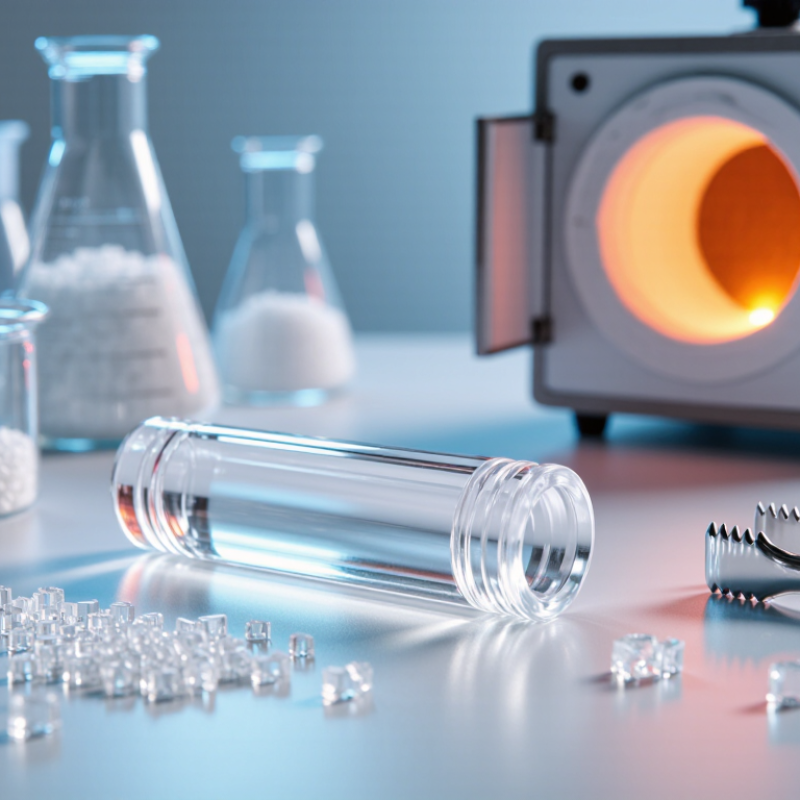
Glass quartz crystal is usually a clear glass object designed to resemble natural quartz. The name can be confusing. In many cases, it does not describe a naturally grown crystal. Instead, it refers to glass with a crystal-like shape, shine, or internal pattern.
True quartz is a mineral made from silicon dioxide. It forms slowly under specific geological conditions and develops a regular atomic structure. Glass also contains silicon dioxide, but its atoms are arranged randomly. This difference affects hardness, optical behavior, and crystal growth. A trained gemologist can examine clarity, internal features, refractive behavior, and hardness before making a reliable identification.
Manufacturers commonly produce glass quartz crystal by melting silica-rich materials at high temperatures. The molten material is shaped in a mold, pressed, or cut into forms such as points and spheres. It then cools into a solid glass piece. Some makers add bubbles, color, or fine lines for a more natural appearance. The result can look striking under a lamp.
Looks can mislead.
A smooth surface does not prove mineral origin. I also think the label deserves more care, because “quartz crystal” may suggest a natural specimen when the product is actually decorative glass. Buyers should request clear material information, production details, and independent testing when authenticity matters. Industry terms are not always consistent. That small uncertainty should be acknowledged.
Glass quartz crystal is a confusing phrase. It often describes glass made to resemble quartz, not genuine quartz crystal. The term may also refer to fused quartz, which is produced from high-purity silica. Although chemically similar, fused quartz lacks the repeating crystal structure found in natural quartz.
Natural quartz forms slowly underground. Heat, pressure, and mineral-rich fluids arrange silicon and oxygen atoms into an ordered lattice. This process can create clear points, cloudy interiors, or visible inclusions. Glass follows a faster route. Manufacturers melt silica at extremely high temperatures, shape the liquid, and cool it before crystals can develop. The result looks crystalline, but its atoms remain randomly arranged.
The difference appears in careful testing. Natural quartz usually shows crystal faces, uneven growth marks, and distinctive inclusions under magnification. Glass may contain round air bubbles, flowing lines, or perfectly repeated shapes. Hardness tests can help, but they may scratch the sample and provide limited evidence. Refractive measurements and microscopic examination are more dependable. A simple visual judgment is often inadequate.
The wording remains imperfect. Some sellers use “quartz” for appearance rather than mineral identity. That does not automatically make the material poor. Glass can offer consistent color, smooth surfaces, and useful optical performance. Natural quartz carries geological history, while glass reflects controlled manufacturing. Checking the material description, production method, and test results gives a more reliable comparison than relying on sparkle alone.
| Comparison Dimension | Quartz Glass / Fused Silica | Natural Quartz |
|---|---|---|
| Basic Definition | An industrial glass made primarily from high-purity silicon dioxide (SiO₂). | A naturally occurring crystalline mineral composed mainly of silicon dioxide (SiO₂). |
| Atomic Structure | Amorphous: its silicon and oxygen atoms do not form a long-range, repeating crystal lattice. | Crystalline: its atoms are arranged in an ordered, repeating structure. |
| How It Is Formed | High-purity silica is melted or formed through vapor-phase processes, then cooled into a solid glass. | It forms naturally when silica-rich fluids or molten geological materials cool and crystallize over long periods. |
| Typical Raw Material | Purified silica sand, crushed quartz, or chemically produced silicon dioxide, depending on the required purity. | Silica-bearing geological fluids, magma, and mineral-rich hydrothermal environments. |
| Melting Behavior | Softens over a temperature range because it is a glass rather than a single crystal. | Has a defined melting point near 1,710°C at atmospheric pressure, although impurities and pressure can affect natural samples. |
| Chemical Composition | Usually very high-purity SiO₂, with the exact purity depending on the manufacturing process and intended use. | Primarily SiO₂, often containing trace elements or inclusions that can produce colors, patterns, or cloudiness. |
| Crystal Form | Does not have a natural crystal habit or crystal faces because it is amorphous. | Commonly forms six-sided prismatic crystals with six-sided pyramidal terminations, although massive and granular forms also occur. |
| Optical Appearance | Typically clear and uniform, but it can also be translucent, opaque, frosted, or colored by additives and processing. | May be clear, milky, smoky, purple, yellow, pink, or otherwise colored by structural defects, trace elements, and mineral inclusions. |
| Refractive Index | Approximately 1.458 at visible wavelengths, with no ordinary-crystal birefringence because the material is isotropic. | Approximately 1.544–1.553 for visible light and normally shows birefringence because of its crystalline structure. |
| Density | About 2.20 g/cm³. | About 2.65 g/cm³. |
| Hardness | Typically around 5.5–6.5 on the Mohs scale, depending on surface condition and testing method. | Mohs hardness of 7, making it harder than ordinary glass and resistant to scratching by common materials. |
| Thermal Expansion | Very low thermal expansion, approximately 0.5 × 10⁻⁶ per °C, which gives excellent resistance to thermal shock. | Higher thermal expansion than fused silica and direction-dependent because of its crystal structure. |
| Thermal Shock Resistance | Excellent. It can tolerate rapid temperature changes better than most conventional glasses and many crystalline materials. | Good heat resistance, but natural crystals may crack from rapid temperature changes, internal inclusions, or structural stresses. |
| Electrical Properties | A strong electrical insulator with low dielectric loss, especially when manufactured at high purity. | Generally insulating, but impurities, defects, moisture, and surface contamination can influence electrical behavior. |
| Chemical Resistance | Highly resistant to water and many acids; hydrofluoric acid and hot concentrated alkaline solutions can attack it. | Generally chemically durable, but it can be etched or dissolved by hydrofluoric acid and affected by certain alkaline conditions. |
| Internal Uniformity | Can be engineered for low bubble content, low inclusions, and consistent composition across large parts. | May contain fractures, fluid inclusions, mineral inclusions, color zones, and growth features created during geological formation. |
| Typical Manufacturing Process | Silica is purified, melted or synthesized, shaped while hot, and annealed to reduce internal stress. Components may then be polished, ground, or coated. | No industrial manufacturing is required for naturally formed specimens; mined crystals may be cut, polished, cleaned, or heat-treated for specific uses. |
| Common Forms | Tubes, rods, windows, plates, lenses, laboratory vessels, light guides, and semiconductor-processing components. | Natural crystal points, mineral specimens, gemstones, aggregate grains, and geological formations. |
| Typical Applications | Laboratory equipment, ultraviolet optical components, high-temperature parts, lighting systems, semiconductor manufacturing, and scientific instruments. | Mineral collections, jewelry, decorative objects, geological research, abrasives, and some specialized piezoelectric applications after processing. |
| Important Terminology Note | “Quartz glass,” “fused quartz,” and “fused silica” generally describe amorphous silica glass. It should not be confused with a natural quartz crystal. | Natural quartz is a crystalline mineral. Man-made synthetic quartz crystals are another category and are different from amorphous quartz glass. |
Glass quartz crystal is usually fused quartz, not ordinary glass with visible crystals. Its main material is silicon dioxide, or SiO₂, supplied as high-purity quartz sand, crushed quartz, or synthetic silica powder. Small amounts of aluminum, titanium, sodium, and iron may remain as trace impurities. They affect color, bubbles, thermal stability, and light transmission. The U.S. Geological Survey’s Mineral Commodity Summaries 2024 estimated U.S. industrial sand and gravel production at nearly 100 million metric tons in 2023. However, only a specialized fraction is suitable for high-quality optical or laboratory glass.
Manufacturers clean and grade the silica before melting it above 1,700°C. Electric furnaces, gas heating, or plasma systems can provide this heat. The molten silica is then formed, cooled, annealed, and inspected for stress. Vacuum treatment may reduce bubbles. Controlled dopants can adjust refractive index or ultraviolet transmission. The USGS Minerals Yearbook identifies glassmaking as a major industrial use of silica, but its broad statistics do not represent high-purity quartz alone. That distinction matters. The name can mislead. A transparent object may be fused silica, while a natural quartz crystal has an ordered lattice.
Tips: Check the material specification, not only the product name. Ask for SiO₂ purity, hydroxyl content, bubble limits, and thermal expansion data. Visual clarity helps, but it cannot prove chemical purity. Even experienced buyers should verify certificates against independent testing.
Quartz glass, often called fused quartz, is not a natural crystal. It is an amorphous material made from high-purity silica. The manufacturing process begins with carefully selected quartz sand. The sand is washed, dried, and screened to remove iron, moisture, and visible particles. Purity matters. The U.S. Geological Survey reported approximately 100 million metric tons of U.S. industrial sand and gravel production in 2023. Only a small, highly controlled fraction suits advanced quartz glass production.
Manufacturers then melt the silica inside an electric furnace or oxyhydrogen flame. Temperatures commonly exceed 1,700°C. The heat breaks the original crystal structure and creates a clear, uniform melt. Workers shape this melt into tubes, plates, rods, or custom components. Forming speed must remain stable. Too quickly, and bubbles or stress may appear. Too slowly, and the surface can deform. The process is less perfect than diagrams suggest.
After forming, the material enters controlled annealing. It cools gradually to reduce internal stress. Technicians inspect transmission, dimensions, bubbles, and metallic contamination. Semiconductor applications demand especially strict control. The World Semiconductor Trade Statistics organization forecast global semiconductor sales of about 611 billion dollars for 2024, supporting continued demand for clean process materials. Testing often includes optical measurement and chemical analysis. One flaw can remain hidden until later machining. That risk deserves more attention. Surface finishing may use grinding, polishing, flame treatment, or precision cutting, depending on the final component.
Quartz glass, also called fused silica, is produced by melting very high-purity silica at temperatures above its melting point and then shaping, annealing, and cooling it under controlled conditions. The temperatures below represent typical process conditions and material reference points; exact values vary with the production method and product geometry.
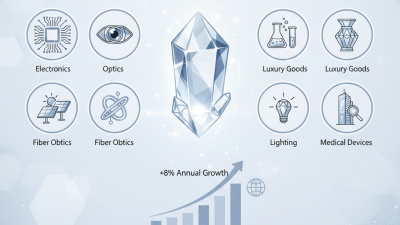
Glass quartz crystal usually means fused quartz, or silica glass. Unlike natural quartz, it has no regular crystal lattice. Manufacturers melt high-purity silicon dioxide above 1,700°C, then cool it into tubes, plates, crucibles, or transparent blocks. Controlled cooling reduces bubbles, contamination, and thermal stress.
Its main use is semiconductor manufacturing. Quartz vessels hold wafers during high-temperature oxidation, diffusion, and cleaning processes. SEMI’s World Fab Forecast projected global semiconductor capacity to exceed 30 million 200-millimeter-equivalent wafers per month in 2024. That expansion supports continuing demand for clean, heat-resistant quartz components. The material tolerates sudden temperature changes and contributes little contamination, which is essential inside a fabrication chamber.
Solar manufacturing is another major application. Quartz crucibles help grow silicon ingots, while quartz tubes support high-temperature processing. The International Energy Agency reported that solar power represented about three-quarters of new renewable capacity added globally in 2023. This scale makes quartz important, although the material is only one part of the supply chain. It also appears in ultraviolet lamps, laboratory vessels, optical systems, and precision heaters.
The details matter.
In practice, quartz glass is not automatically pure enough for every process. Impurities, surface damage, and repeated thermal cycling can reduce performance. A 2024 USGS Mineral Commodity Summaries report also shows that quartz-related production statistics are often grouped within broader industrial mineral categories. That limitation makes simple market-size claims less reliable than they appear.