Leave Your Message
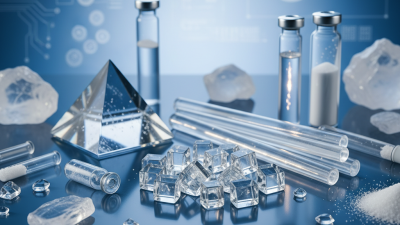
Glass Quartz Crystal is becoming a more specialized category for lighting, electronics, décor, and precision components in 2026. Buyers now examine clarity, thermal stability, geometry, and surface finish more carefully. The term can be confusing. Some products use natural quartz, while others use fused silica or decorative glass with quartz-like features. They are not interchangeable.
Industry data supports continued attention to this material group. Grand View Research’s quartz market analysis identifies electronics, solar technology, and optical applications as major demand areas. Fortune Business Insights also reports steady growth in the global quartz market, supported by construction, semiconductors, and engineered surfaces. The U.S. Geological Survey’s Mineral Commodity Summaries emphasizes silica’s importance in glassmaking, foundry work, and high-technology manufacturing. These reports do not classify every decorative item as crystal. That distinction matters.
This guide compares the top Glass Quartz Crystal types expected to attract attention in 2026. It considers clear fused quartz, smoky and colored varieties, optical-grade forms, and decorative crystal glass. Each type has different strengths. Some tolerate intense heat. Others create richer visual effects under warm lighting. A product may look flawless online but show bubbles, uneven edges, or weak transparency in person. That is a practical risk.
Technical claims should be checked against supplier specifications, test certificates, and application requirements. Price alone is unreliable. A lower-cost piece may contain more inclusions or use ordinary glass instead of quartz-based material. This review therefore combines market evidence with manufacturing knowledge and buyer experience. It is not perfect. Definitions still vary across suppliers, and 2026 product labeling may remain inconsistent.
What Defines Glass Quartz Crystals in 2026?
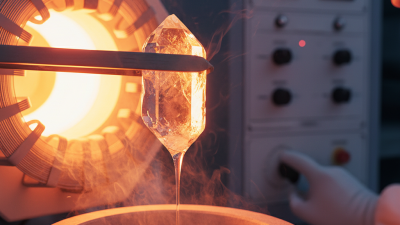
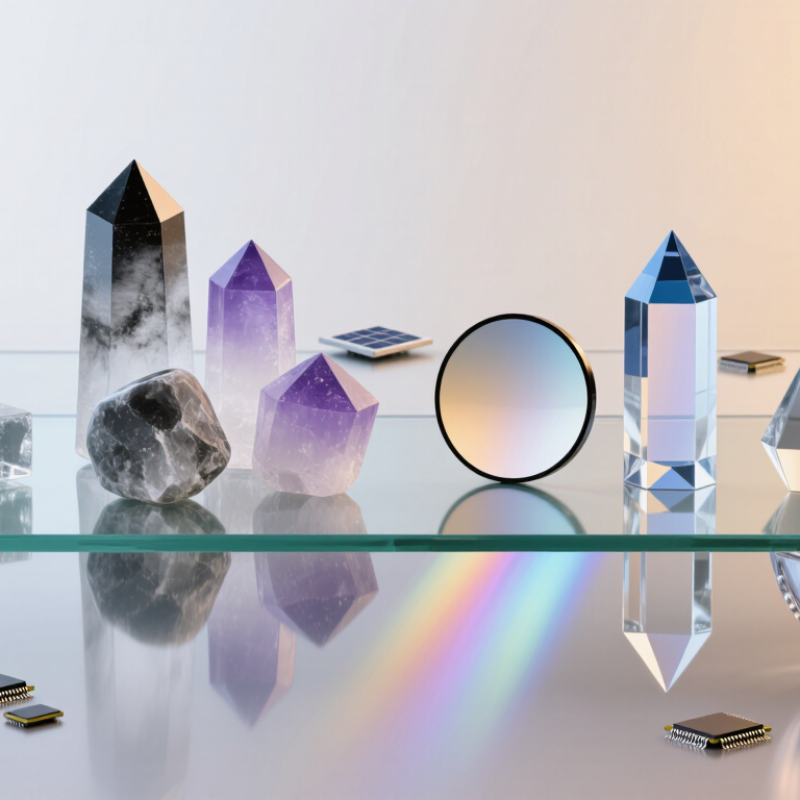
In 2026, “glass quartz crystal” remains an imprecise market phrase. True quartz is crystalline silicon dioxide, while ordinary glass has an amorphous structure. Fused silica sits between common descriptions, offering high purity, heat resistance, and a glass-like appearance without quartz’s natural crystal form. This difference matters when comparing clear points, decorative clusters, laboratory-grown quartz, and glass imitations.
Experienced buyers examine more than sparkle. A ten-power loupe may reveal natural inclusions, growth lines, tiny fractures, or rounded gas bubbles. Sharp internal planes often support a crystalline identity, while perfectly uniform clarity can suggest manufactured material. Hardness testing may help, but it can damage a polished surface. Refractive measurements are safer when performed by a trained specialist.
Color also defines popular 2026 types. Clear quartz emphasizes light transmission and internal reflections. Smoky varieties show gray-brown tones caused by natural radiation effects or controlled treatment. Rose, citrine, and vivid decorative colors may involve heating or color enhancement, so sellers should state the process clearly. Lab-grown quartz can provide consistent geometry and fewer visible flaws.
The label still feels imperfect. Some listings use “glass quartz” for visual style rather than mineral science. That creates confusion, especially for first-time buyers. Reliable descriptions should identify composition, origin, treatment history, dimensions, and testing methods. Photographs help, but they cannot replace physical examination. Even trained observers can misjudge a crystal from images alone.
“Quartz glass” usually means fused silica: silica that has been melted and cooled into a non-crystalline, amorphous material. It is different from natural quartz, which has an ordered crystal structure. The table compares widely recognized quartz varieties with fused silica for clarity.
| Type | Material and structure | Typical appearance | Key characteristics | Common uses |
|---|---|---|---|---|
| Rock crystal (clear quartz) | Crystalline silicon dioxide (SiO₂), usually alpha quartz with a trigonal crystal structure. | Colorless and transparent to translucent; may contain visible inclusions or fractures. | Mohs hardness about 7; density about 2.65 g/cm³; refractive index approximately 1.544–1.553. | Jewelry, decorative objects, optical components, and electronic resonators. |
| Amethyst | Purple variety of crystalline quartz; its color is associated with iron impurities and natural irradiation. | Pale lilac to deep violet, sometimes with color zoning. | Shares quartz’s approximate hardness of 7 and density of 2.65 g/cm³; color can fade with prolonged exposure to heat or strong light. | Faceted gems, beads, carvings, and mineral specimens. |
| Citrine | Yellow-to-orange variety of crystalline quartz; natural color is associated with iron-related color centers. Some material sold as citrine is heat-treated amethyst. | Pale yellow through golden or orange-brown, commonly transparent. | Quartz-like hardness and density; natural citrine is generally less common than heat-treated material. | Jewelry, cabochons, and decorative crystal pieces. |
| Rose quartz | Pink variety of crystalline quartz; its color is linked to trace elements, microscopic inclusions, or color centers, depending on the material. | Usually translucent, with a soft pink color; transparent crystals are uncommon. | Mohs hardness about 7; often occurs in massive, rather than well-formed individual crystal, pieces. | Beads, carvings, cabochons, and ornamental objects. |
| Smoky quartz | Brown-to-gray variety of crystalline quartz; its color is commonly associated with irradiation acting on aluminum-related impurities. | Transparent to translucent, ranging from pale gray-brown to deep smoky brown. | Retains the typical hardness and density of quartz; color intensity varies between specimens. | Jewelry, carvings, and mineral collections. |
| Milky quartz | Crystalline quartz containing abundant microscopic fluid inclusions or other light-scattering features. | White to translucent, with a cloudy or milky appearance. | Quartz composition and crystal structure; reduced transparency results from scattering within the material. | Decorative stone, carvings, and mineral specimens. |
| Fused silica (quartz glass) | High-purity silica glass with an amorphous structure; it has no long-range crystal lattice and is not a quartz crystal. | Usually clear and colorless when manufactured with low impurity content; can also be made opaque or tinted. | Refractive index about 1.458 near 589 nm; density about 2.20 g/cm³; very low thermal expansion, approximately 0.5 × 10⁻⁶ K⁻¹ near room temperature. | Laboratory ware, optical windows, UV-transmitting components, and high-temperature applications. |
Values are typical reference figures and may vary with composition, inclusions, temperature, and measurement method. Natural quartz and fused silica are distinct materials despite both being primarily silicon dioxide.