Top 10 Fascinating Quartz Optical Properties You Should Know?
Quartz is a fascinating mineral with unique optical properties. These Quartz Optical Properties make it valuable in various applications, from electronics to jewelry. Understanding these features can deepen our appreciation for this abundant mineral.
The extraordinary ability of quartz to manipulate light sets it apart. Its transparency and birefringence produce stunning visual effects. You might notice how it refracts light beautifully in rings and pendants. These remarkable traits are not just aesthetics; they have practical implications in technology.
Exploring Quartz Optical Properties can reveal both wonders and limitations. While quartz remains durable, certain conditions can affect its clarity and brilliance. This duality in nature invites us to reflect on the material's complexities. By learning more, we enhance our understanding of this incredible mineral and its role in our lives.
Unique Crystal Structure of Quartz and Its Impact on Optical Properties
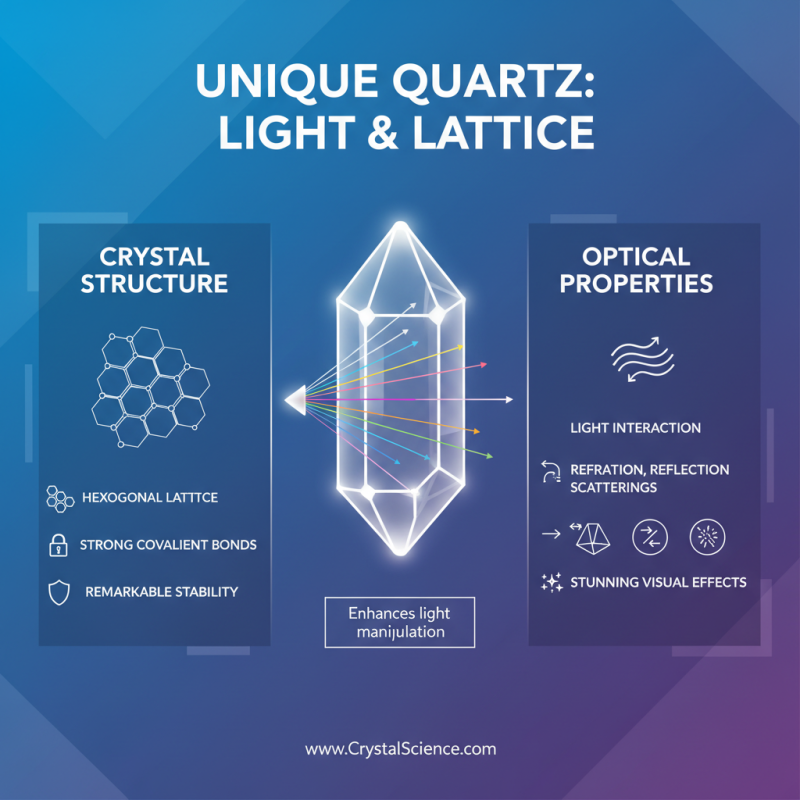
Quartz exhibits a unique crystal structure that significantly influences its optical properties. This crystal arrangement features a hexagonal lattice, allowing for various light interactions. The strong covalent bonds within the quartz structure provide remarkable stability. As light enters quartz, it can refract, reflect, or even scatter, creating stunning visual effects.
The optical characteristics of quartz include birefringence. This property describes how light splits into two rays when passing through the crystal. Its double refraction creates intriguing images, which are often utilized in various optical applications. Quartz also displays piezoelectricity. When mechanically stressed, it generates an electrical charge. This phenomenon is crucial in many electronic devices and scientific instruments.
While quartz is largely reliable for optical applications, it can present challenges. Flaws within the crystal structure may affect clarity and light transmission. Variations in impurities can lead to colored quartz, such as amethyst or citrine. These imperfections should be carefully evaluated, particularly in high-precision environments. It's essential to understand both the strengths and limitations of quartz's optical properties for effective use in technology and natural sciences.
Light Transmission and Refraction Characteristics of Quartz Crystals
Quartz crystals are known for their remarkable optical properties, especially their ability to transmit and refract light. These features make quartz invaluable in various applications, from electronics to jewelry. Reports indicate that quartz can achieve a light transmission rate of up to 90%. This high level of clarity allows for minimal distortion when light passes through, making quartz an ideal choice for optical components.
The refraction index of quartz typically ranges from 1.54 to 1.55. This narrow range contributes to its effective use in lenses and prisms, where precision is paramount. However, despite these advantages, the birefringence in quartz can create challenges. Birefringence leads to double refraction, complicating how light behaves as it interacts with these crystals. Such characteristics necessitate careful consideration during the design of optical systems.
Quartz not only offers these essential optical traits but also displays unique colors due to its mineral content. The presence of iron can lead to hues of yellow or purple. Variability in color impacts its aesthetic appeal. This allure, paired with its optical efficiency, makes quartz a fascinating subject of study for both scientists and enthusiasts. While the data shows many benefits, the nuances of quartz behavior with light remind us of the complexity inherent in this seemingly simple mineral.
Top 10 Fascinating Quartz Optical Properties You Should Know
| Property |
Description |
Value |
| Light Transmission |
Ability of quartz to transmit light, varying with thickness and impurities. |
>90% |
| Refraction Index |
The ratio of the speed of light in a vacuum to its speed in quartz. |
1.54–1.55 |
| Birefringence |
The difference in refractive indices in different crystallographic directions. |
0.009 |
| Polarization |
Quartz can polarize light, important for optical applications. |
Yes |
| Dispersion |
Separation of light into colors, less pronounced than in glass. |
0.014 |
| Thermal Conductivity |
Ability of quartz to conduct heat, important for temperature stability. |
1.3 W/m·K |
| Photoelasticity |
Change in refractive index under mechanical stress. |
Significant |
| Cleavage |
Quartz has no perfect cleavage; breaks with conchoidal fractures. |
No |
| Transparency |
Varies with purity; most are transparent to translucent. |
Transparent |
| Aging |
Quartz maintains stability over time, with minimal optical degradation. |
Stable |
Color Variations in Quartz: Causes and Optical Implications
Quartz exhibits a stunning array of color variations. These colors arise from various factors, including impurities and crystal structures. For instance, iron can give quartz a pink hue, while manganese can lead to a rich purple. The presence of these elements alters how light interacts with the mineral, showcasing its optical complexity.
Different color variants of quartz also affect its transparency and luster. Amethyst, for example, can appear translucent to opaque. This variability creates diverse appearances even within the same type of quartz. The fascinating interplay of light and color can sometimes lead to optical illusions, challenging our perception. Such unique properties warrant deeper exploration and appreciation.
However, interpreting quartz colors isn’t always straightforward. Some colors might fade over time due to sun exposure. Other color variations may be subtle and easily overlooked. This complexity invites reflection on how environmental factors influence natural beauty. Understanding these nuances enhances our appreciation of quartz and its optical wonders.
Top 10 Fascinating Quartz Optical Properties You Should Know
This bar chart illustrates the color variations in quartz based on different impurities that affect its optical properties. The data represents the percentage of occurrence of each color variation caused by specific impurities found in quartz.
Piezoelectric Effect in Quartz and Its Applications in Optics
Quartz exhibits remarkable optical properties, one of which is its piezoelectric effect. This phenomenon occurs when quartz generates an electric charge in response to applied mechanical stress. As a result, quartz is extensively used in various optical applications, including sensors and resonators. The ability to convert mechanical energy into electrical signals enhances the performance of devices.
In optics, the piezoelectric effect allows for precision control in devices such as laser systems and frequency modulators. When quartz crystals are used, they provide stability and accuracy. These properties are crucial in telecommunications and instrumentation. However, the dependence on precise conditions can be a challenge. Variations in temperature or pressure can affect the output.
Another aspect to consider is that while quartz is reliable, it is not invulnerable. Prolonged exposure to extreme environmental conditions can degrade its properties. It is important to understand these limitations for effective use. Users must be mindful of these factors to optimize performance in practical applications. Engaging with this natural crystal’s unique attributes may require continuous learning and adaptation.
Thermal and Chemical Stability of Quartz Under Various Conditions
Quartz is known for its impressive thermal and chemical stability. Under extreme heat, quartz maintains its structural integrity. Research shows that it can withstand temperatures up to 1,700°C before melting occurs. This property makes quartz ideal for various industrial applications, including electronics and glass manufacturing.
Chemical resistance is another fascinating aspect. Quartz does not easily react with most acids and bases. It is stable in environments with pH levels ranging from 3 to 10. However, prolonged exposure to hydrofluoric acid can etch its surface. Thus, while it is highly stable, some chemicals can affect its durability.
Despite its strengths, quartz is not without flaws. In environments with rapid temperature changes, stress fractures can develop. This can compromise its overall efficiency in specific applications. Therefore, careful consideration is essential when selecting quartz for high-performance uses. Balancing its properties with potential vulnerabilities showcases the need for ongoing research and practical testing.