Leave Your Message

Top 10 Quartz Optical Properties You Should Know?

Quartz, a widely studied mineral, is renowned for its unique optical properties. Dr. Elena Mirov, a leading expert in mineral optics, once said, "Understanding Quartz Optical Properties is crucial for advancements in various industries." These properties determine how light interacts with quartz, influencing applications in technology, jewelry, and scientific research.

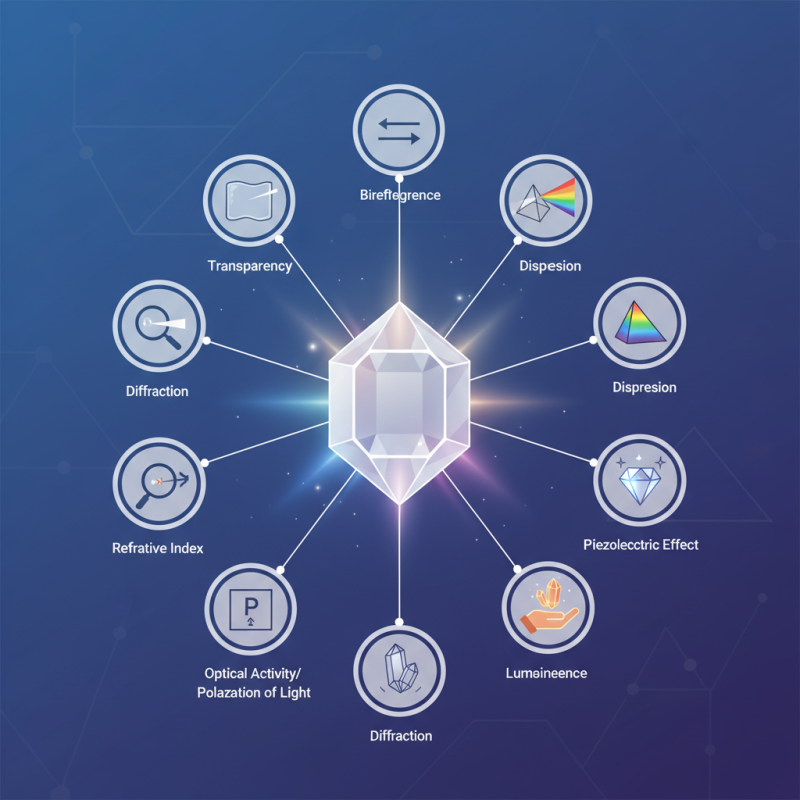
From birefringence to transparency, these features shape the functionality of quartz in practical use. Notably, the refractive index and dispersion characteristics highlight its versatility. Yet, many overlook the subtleties in its optical behavior. This knowledge gap can lead to misunderstandings in material selection or application.

Exploring Quartz Optical Properties reveals both clarity and complexity. Each property plays a role in defining quartz's applications. As industries evolve, refining our understanding becomes paramount. This journey into quartz optics is not just about facts; it challenges us to think critically about how we utilize natural minerals in our advancing world.
Top 10 Quartz Optical Properties You Should Know?

Top Quartz Optical Properties: An Overview of Essential Characteristics

Top 10 Quartz Optical Properties You Should Know?

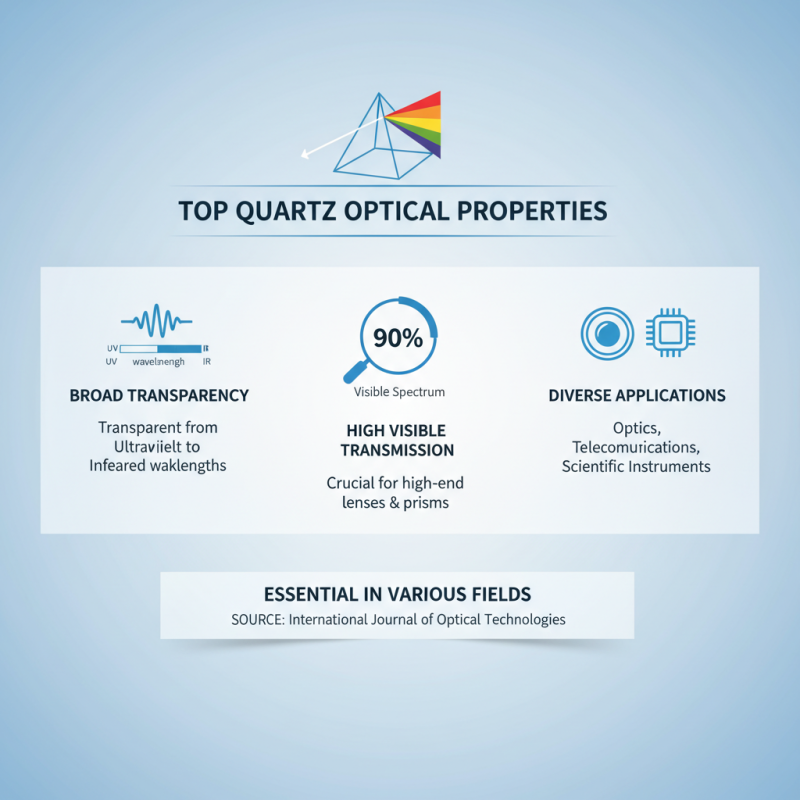
Quartz exhibits unique optical properties that make it essential in various fields. Its transparency ranges from ultraviolet to infrared wavelengths, allowing diverse applications in optics. According to a report by the International Journal of Optical Technologies, quartz transparency reaches 90% in the visible spectrum. This feature enables its use in high-end lenses and prisms.

Another critical property is its birefringence, which can affect light polarization. Birefringence occurs due to the internal structure of quartz. Research indicates that this characteristic leads to distinct light behaviors when interacting with different quartz orientations. Yet, producing high-quality quartz for optical applications is challenging. Common impurities can impact clarity and performance.

The refractive index of quartz, averaging around 1.54, is another notable trait. This measurement influences how light bends when it passes through the material. Properly calibrated quartz can enhance imaging systems significantly. However, using quartz in optics requires strict adherence to quality standards. Minor deviations in size or clarity can result in performance issues. Understanding these properties is essential for mastering the use of quartz in high-precision applications.
Refractive Index of Quartz: Understanding Light Propagation and Interaction

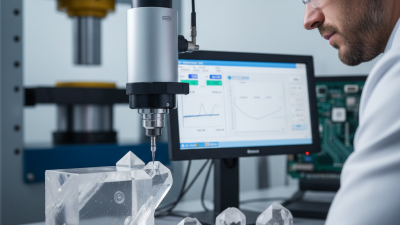
Quartz is well-known for its unique optical properties, particularly its refractive index. This property influences how light interacts with quartz crystals. The refractive index of quartz is about 1.54. This means light slows down when entering the crystal. This slowing affects light's path, bending it as it passes through.

When working with quartz, consider how it can focus or disperse light. For many applications, understanding this behavior is crucial. For instance, using quartz in optical devices requires knowledge about its light propagation. Inaccurate assumptions can lead to ineffective designs.

Tips: Always measure the refractive index under various conditions, such as temperature and wavelength. Small changes can significantly affect performance. Experiment with different angles to see how light behaves around quartz. Each test brings new insights. Always reflect on your findings to refine your approach.

Top 10 Quartz Optical Properties: Refractive Index and Light Interaction

Birefringence in Quartz: Implications for Optical Applications and Measurement

Birefringence is a critical optical property of quartz that influences its applications. It occurs when light passes through quartz, splitting into two rays. This effect leads to double refraction, which is essential for various optical devices. In industries like telecommunications and microscopy, understanding birefringence in quartz enhances measurement accuracy.

When using quartz crystals, small variations in composition can affect birefringent properties. Factors such as temperature and stress also play roles. This complexity invites reflection. Are you measuring accurately? A slight change in environment can alter readings. Ensure your equipment is calibrated, and test under consistent conditions.

For practical applications, consider these tips. Always observe under polarized light to assess birefringence effectively. Experiment with different quartz samples to learn how each behaves. Document your findings to build a robust reference guide. In your journey of exploration, embrace the imperfections. Each measurement can teach you something new.

Absorption Spectrum of Quartz: Key Wavelengths and Their Significance

Top 10 Quartz Optical Properties You Should Know?

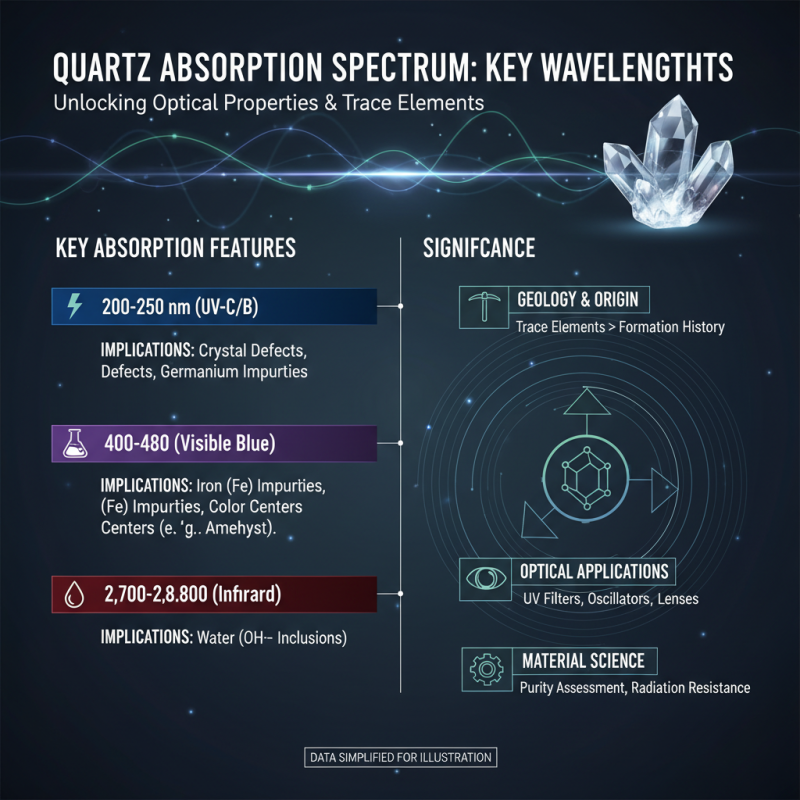
The absorption spectrum of quartz plays a pivotal role in understanding its optical properties. Quartz is a common mineral, yet its interactions with light are complex. It exhibits distinct absorption features at specific wavelengths. These features often indicate the presence of trace elements. For instance, certain wavelengths can signify iron impurities, essential for geologists studying quartz evolution.

Key wavelengths have unique significance in various applications. For example, around 220 nm, quartz absorbs most ultraviolet light. This characteristic makes it valuable in optics and electronics. By absorbing UV radiation, quartz helps protect sensitive materials. Furthermore, its transparency in the visible light range makes quartz suitable for lenses and prisms.

However, there's much we still don't know about how quartz interacts with different wavelengths. The nuances of absorption can differ across quartz samples. Factors like purity and temperature can change its spectral response. This variability raises questions about consistent applications in technology and research. Understanding these factors is crucial for harnessing quartz's full potential in various fields.

Thermal Stability of Quartz: Impact on Optical Performance in Various Environments

Thermal stability is crucial for the optical performance of quartz in various environments. Quartz can withstand a wide range of temperatures, making it suitable for many applications. However, high temperatures can alter its optical properties, leading to concerns in precision optics. For example, significant heat can cause changes in reflectivity and refractive index, which can affect light transmission.

When utilizing quartz in different settings, consider the local temperature fluctuations. This knowledge guides material selection. Pay attention to the thermal expansion of quartz; it differs from metals and other materials. Such mismatches can lead to stress fractures over time.

Tips: Always conduct thermal tests on quartz in your specific environment before finalizing your applications. Understanding thermal boundaries is vital. Ensure your project has a thermal management plan to mitigate risks. Monitoring equipment regularly can help identify any early signs of thermal stress. This awareness can prolong the lifespan of your optical components.

Top 10 Quartz Optical Properties You Should Know

Property Description Impact on Optical Performance Applications
Refractive Index A measure of how much light bends when entering quartz. Key for lens design and light gathering efficiency. Optical fibers, lenses.
Thermal Stability Ability to maintain optical characteristics at varying temperatures. Ensures consistent performance in fluctuating environments. Industrial optics, sensors.
Transmission Spectrum Range of wavelengths that can pass through quartz. Critical for applications in UV to IR sensors and devices. Spectroscopy, imaging systems.
Birefringence Variation in the refractive index depending on polarization. Affects the clarity and quality of optical images. Optical instruments, stress analysis.
Non-linearity Response of quartz to electric fields and light intensity. Can enhance signal processing capabilities. Laser technology, optical communication.
Photoluminescence Light emission from quartz when exposed to radiation. Useful for material characterization and diagnostics. Material science, geological surveys.
Absorption Coefficient Indicates how much light is absorbed as it passes through. Affects clarity and prevents loss of light in devices. Optical cavities, telecommunications.
Thermal Expansion Coefficient Rate at which quartz expands with temperature increase. Important for stability in varying thermal conditions. Precision optics, sensors.
Chemical Resistance Resistance to chemical degradation and reaction. Ensures longevity and reliability in harsh environments. Laboratory equipment, environmental monitoring.
Mechanical Strength The strength of quartz under mechanical stress. Affects durability in manufacturing and applications. Construction materials, precision devices.