Leave Your Message

What Is a Quartz Fiber Filter and How Does It Work?

A Quartz Fiber Filter is a specialized porous membrane used to collect fine particles from air and other gas streams. It is made from high-purity quartz fibers, bonded into a thin, stable sheet. Unlike ordinary paper filters, it tolerates elevated temperatures and many chemical conditions. This makes it valuable in environmental monitoring, industrial hygiene, combustion studies, and atmospheric research.

Its operation is simple in principle. A pump draws air through the filter at a controlled flow rate. Suspended particles collide with, touch, or move toward the quartz fibers. They become trapped throughout the filter’s depth, while cleaner air continues downstream. Particle size, airflow, fiber arrangement, and humidity all influence collection efficiency. The filter does not “recognize” harmful particles. It only captures them through physical filtration and related surface effects.

In practical testing, technicians often condition and weigh each filter before and after sampling. A visible gray deposit may reveal heavy loading, but appearance alone cannot prove composition. Laboratory analysis may use gravimetric measurement, ion chromatography, microscopy, or thermal methods. Clean handling is essential because skin oils, dust, and volatile residues can alter results. Quartz is stable, but it is not perfect. It can break during installation, and blank correction may still be necessary. Good procedures, documented calibration, and careful interpretation make the data more trustworthy. Small details matter.
What Is a Quartz Fiber Filter and How Does It Work?

Definition and Basic Structure of a Quartz Fiber Filter

What Is a Quartz Fiber Filter and How Does It Work?

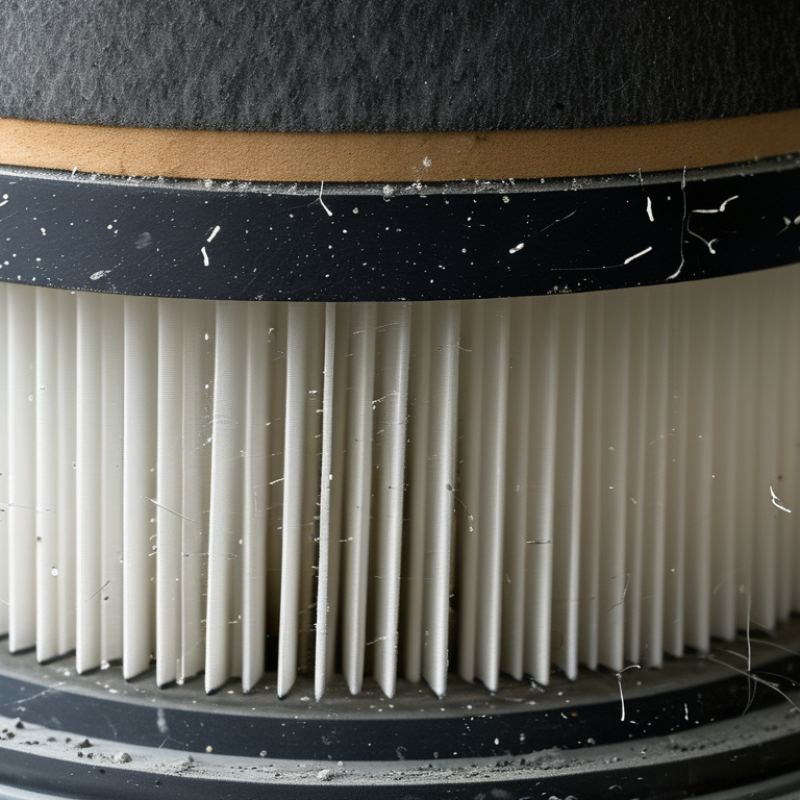
A quartz fiber filter is a porous, disc-shaped material made from high-purity silica fibers. The fibers form a random, three-dimensional web rather than a solid screen. This basic structure creates open pathways for air while retaining fine particles on and within the filter. Many laboratory-grade filters are binder-free, reducing possible chemical interference during analysis. They are also highly resistant to heat, which supports thermal treatment of collected carbon samples.

During sampling, a pump draws air through the filter. Particles are captured through interception, inertial impaction, and diffusion. Smaller particles may travel deeper into the fiber network. Larger particles usually remain near the surface. The filter therefore acts as both a collection surface and a shallow particle reservoir.

The 2021 World Health Organization Global Air Quality Guidelines set the annual PM2.5 guideline at 5 µg/m³, showing why reliable fine-particle sampling matters. Small errors become significant at such low concentrations.

Quartz fiber filters are widely used for particulate carbon and elemental analysis. Thermal-optical methods heat the sample step by step and measure carbon fractions. Guidance from the U.S. Environmental Protection Agency’s Chemical Speciation Network supports this type of sampling practice. Yet quartz is not chemically perfect. It can adsorb some organic vapors, creating positive sampling artifacts. Field blanks and parallel samples are essential. Handling still matters. A fingerprint, uneven loading, or a poor seal can distort results. Even experienced laboratories should question unusually clean or unusually high readings.

Materials and Properties That Enable Quartz Fiber Filtration

Quartz fiber filters are formed from high-purity silica fibers, creating a tangled, porous web. Their chemistry gives them low metal content and strong resistance to heat. Many laboratory procedures heat these filters above 800°C during carbon analysis. The fibers capture particles through interception, diffusion, and inertial impaction. Smaller particles move deeper into the network.

This material is especially useful for measuring carbonaceous aerosols. The IMPROVE monitoring protocol uses quartz filters in thermal-optical carbon analysis. The method separates organic carbon from elemental carbon by controlled heating and optical correction. Quartz also supports accurate laboratory digestion because it contributes little ash. That matters when samples contain only micrograms of particulate matter. It is not magic, though.

The World Health Organization’s 2021 air-quality guidelines recommend an annual PM2.5 limit of 5 µg/m³. The European Environment Agency reported that 96% of Europe’s urban population remained above this guideline in 2022. These figures explain the need for sensitive sampling materials. Yet quartz can adsorb gas-phase organic compounds, creating positive sampling artifacts. Humidity may also change particle behavior. Experienced technicians use field blanks, conditioning, controlled storage, and duplicate samples. Small handling errors can outweigh the filter’s excellent material properties. A cleaner procedure is sometimes more valuable than a more expensive filter.

How Particles Are Captured During the Filtration Process

A quartz fiber filter is a heat-resistant, porous collection medium used in air-quality and aerosol sampling. A filter does not simply act like a sieve. Air passes through its tangled fibers, while particles follow different paths. Larger particles strike fibers by inertial impaction. Medium-sized particles touch fibers through interception. Very small particles move randomly through Brownian diffusion and eventually contact the fiber surface. Some particles also adhere through weak surface forces.

As sampling continues, the captured material forms a thin dust layer. This layer can improve collection efficiency, but it also increases pressure drop. A visibly loaded filter may therefore need more pumping power. NIOSH Method 5040 uses quartz fiber filters for thermal-optical carbon analysis, showing their practical value in detailed particulate research. The method also requires careful handling because heating can separate organic carbon from elemental carbon imperfectly. That separation is not always clean.

The World Health Organization’s 2021 Air Quality Guidelines set annual PM2.5 guidance at 5 µg/m³. Such low concentrations demand clean filters, stable flow, and reliable blank correction. Quartz can withstand high-temperature analysis, yet it may adsorb organic vapors before sampling. This creates a positive measurement artifact. Volatile compounds may also leave the filter during transport, creating a negative artifact. The Health Effects Institute’s State of Global Air 2024 report linked air pollution to 8.1 million deaths in 2021, reinforcing the need for defensible measurements. In practice, filter conditioning and field blanks remain essential, though neither eliminates every uncertainty.

Common Types and Applications of Quartz Fiber Filters

What Is a Quartz Fiber Filter and How Does It Work?

Common Types and Applications of Quartz Fiber Filters

Quartz fiber filters are porous sheets made from finely spun silica fibers. Their open structure traps airborne particles through interception, impaction, and diffusion. Air passes through the filter, while dust, smoke, and fine particulate matter remain on its surface or within its depth.

The most common type is the round quartz fiber disc, used in portable air samplers and laboratory holders. High-purity discs are suitable for trace analysis because they add relatively little background contamination. Binder-free filters tolerate high temperatures and are often selected for thermal analysis. Thicker quartz filters provide greater particle capacity, while thinner versions can offer lower airflow resistance. Cylindrical and cartridge-style designs support continuous sampling systems.

Quartz fiber filters are widely used for environmental air monitoring, workplace exposure studies, stack emission testing, and research on carbon-containing particles. Analysts may heat the filter to remove organic residues or examine collected material with chemical and optical methods. Their thermal stability makes them useful when samples require controlled heating.

They are not indestructible. Handle them with clean, blunt-ended tools. A small crease can change the sampled area or create an uneven airflow path. Quartz can also absorb moisture, affecting mass measurements. Conditioning, weighing, and blank correction improve reliability. In practice, careless storage may cause larger errors than the filter’s stated specifications. That deserves attention.

What Is a Quartz Fiber Filter and How Does It Work?

Quartz fiber filters are made from high-purity silica fibers. Air passes through the porous fiber network, while particles are retained by interception, impaction, and depth filtration. Their low background and thermal stability make them useful for aerosol and emission sampling.

The chart shows representative air-sampling temperature windows in which quartz fiber filters are commonly used. Actual limits depend on filter construction, holder design, exposure time, humidity, and the sampling method.

Factors Affecting Filter Performance and Selection

What Is a Quartz Fiber Filter and How Does It Work?

Quartz fiber filters collect airborne particles through depth filtration. Their fine, heat-resistant fibers capture particulate matter while allowing air to pass. Researchers often use them for carbon, sulfate, nitrate, and trace-element analysis. Their performance depends on more than fiber material.

Airflow is a major factor. Higher face velocity can increase pressure drop and reduce collection consistency. Filter loading creates another problem. A darkened surface may trap particles efficiently, but it can also change airflow resistance. Humidity may weaken handling and affect particle mass. The U.S. EPA Chemical Speciation Network guidance highlights controlled flow, conditioning, and blank correction for reliable aerosol measurements. These steps matter because the WHO Global Air Quality Guidelines set annual PM2.5 guidance at only 5 µg/m³ and a 24-hour level of 15 µg/m³.

Temperature selection deserves attention. Quartz remains useful in heated sampling and carbon analysis, but extreme conditions can increase background contamination. Filter purity, binder content, pore structure, diameter, and effective collection area should be checked together. A larger filter may reduce pressure drop, yet it may require more extraction solvent. A tighter structure can improve retention, but sampling becomes slower.

No filter is perfectly neutral. Field blanks, storage time, and operator handling can shift results. That uncomfortable detail is easy to overlook. Selection should match the target analyte, sampling duration, airflow, and laboratory method, rather than relying on nominal efficiency alone. Calibration records and repeat measurements reveal weaknesses that product sheets cannot.

What Is a Quartz Fiber Filter and How Does It Work? – Factors Affecting Filter Performance and Selection

Performance or Selection Dimension Typical Characteristics Effect on Performance and Recommended Selection Approach
Filter Material A nonwoven mat made from high-purity, randomly arranged quartz or fused-silica fibers. Quartz provides a rigid inorganic structure, high thermal stability, and low trace-element background. Select a grade with suitable purity when the collected sample will be analyzed for metals, ions, or carbon-containing species.
Filtration Mechanism A combination of interception, inertial impaction, diffusion, and, for some particles, electrostatic effects. Performance is influenced by fiber diameter, web structure, thickness, face velocity, and particle size. A nominal pore-size label alone does not fully describe aerosol collection efficiency.
Particle Collection Range Suitable for collecting airborne particulate matter from coarse particles down to submicrometer aerosols when the filter and sampling conditions are properly matched. For fine-particle sampling, verify the efficiency at the target particle size and operating flow rate. Do not assume that every quartz fiber filter provides the same fine-particle performance.
Temperature Resistance Quartz fibers tolerate substantially higher temperatures than common cellulose or polymeric filter media; many laboratory grades are used for short-term heating or thermal treatment. The actual limit depends on binder content, mounting hardware, heating time, atmosphere, and manufacturer specifications. Confirm the rated temperature before combustion, ashing, or thermal analysis.
Organic Binder Content Some quartz filters are binder-free, while others may contain a small amount of binder to improve mechanical strength. For gravimetric, elemental carbon, organic carbon, or high-temperature applications, choose a binder-free or low-background option when appropriate. Preheating may reduce contamination from volatile residues, but it does not correct every source of background.
Pressure Drop Generally low to moderate at common air-sampling flow rates, but it increases with filter thickness, loading, face velocity, and accumulated dust. Use a filter with sufficient permeability for the pump capacity. Excessive pressure drop can reduce the actual flow rate, shorten sampling duration, and cause premature pump overload.
Airflow Rate Compatible flow depends on diameter, thickness, holder design, particle loading, and the required sampling method. Select the filter size and holder together. Verify the flow under loaded conditions rather than relying only on the initial flow reading, and calibrate the sampling train before and after use.
Moisture Behavior Quartz is inorganic and noncombustible, but the fibrous structure can retain moisture, and water may affect weighing and some analytical results. Condition filters at controlled temperature and relative humidity before weighing. Protect filters from condensation during sampling, transport, and storage.
Chemical Compatibility Quartz has good resistance to many acids and solvents, but concentrated alkaline solutions and hydrofluoric acid can attack silica. Check compatibility with the sampled aerosol, extraction solvent, cleaning solution, and any digestion procedure. Avoid hydrofluoric acid unless the method specifically accounts for silica dissolution.
Blank and Background Control Quartz filters can contribute measurable backgrounds for certain carbon fractions, ions, or trace elements depending on purity, processing, storage, and handling. Run field blanks, laboratory blanks, and handling blanks. Use the same conditioning and analytical procedure for blanks and samples, and subtract blank values only when the method permits it.
Mechanical Strength The filter is rigid and heat-resistant but can be brittle, especially after heating or chemical treatment. Handle with clean, nonmetallic or suitable laboratory forceps. Select a reinforced or supported format when high flow, long sampling periods, or repeated handling could cause tearing or edge damage.
Filter Diameter and Shape Common laboratory formats include circular discs, with diameter selected to match the sampling cassette, holder, or analytical instrument. The filter must seat evenly and seal correctly in the holder. An incorrect diameter can cause bypass leakage, uneven loading, or difficulty recovering the entire sample.
Surface Loading and Dust Capacity The fibrous depth structure can capture particles throughout the media, while heavy surface loading progressively increases resistance. Estimate expected mass loading before selecting thickness and area. Replace or stop sampling when the flow becomes unstable, the pressure drop exceeds the method limit, or the deposit interferes with analysis.
Analytical Application Common uses include airborne particulate sampling, combustion aerosol studies, high-temperature gravimetry, elemental analysis, and carbon-fraction measurements. Choose the media based on the complete method, including digestion, thermal treatment, optical analysis, weighing, and required detection limits. A filter suitable for one analysis may introduce unacceptable background in another.
Sterilization and Heating Quartz can withstand dry-heat treatment better than many polymeric media, subject to the limitations of the holder and any binder or contamination present. Use a validated heating program that specifies temperature, duration, atmosphere, cooling, and storage. Avoid thermal shock and protect the filter from contamination after treatment.
Storage and Contamination Prevention Filters can collect airborne fibers, dust, volatile compounds, and handling residues before use or after sampling. Store filters in clean, sealed containers or approved petri dishes. Separate unused, exposed, and blank filters, and minimize contact with skin, metal surfaces, and dusty work areas.
Quality Control Checks Important checks include visual inspection, tare-mass stability, blank analysis, leak testing, flow calibration, and pressure-drop monitoring. Define acceptance limits before testing. Reject filters with tears, pinholes, nonuniform areas, visible contamination, unstable mass, or poor fit in the sampling holder.
Note: Actual filtration efficiency, pressure drop, temperature limit, chemical resistance, and background depend on the specific filter construction and test method. Always verify the applicable technical specification and sampling standard before use.