China Top Quartz How Strong Is Quartz for Global Buyers?
Quartz is widely chosen by global buyers for countertops, wall panels, floors, and commercial interiors. China’s quartz manufacturers serve many markets, offering engineered slabs in varied colors, thicknesses, and surface finishes. Yet attractive samples do not prove dependable performance. Buyers need evidence.
The Strength Of Quartz depends on more than hardness alone. Resin content, mineral grading, pressing pressure, curing control, and slab thickness all influence daily durability. A well-made surface can resist scratches, stains, moisture, and moderate impact in demanding environments. However, quartz is not indestructible. Strong point impacts, excessive heat, poor installation, or unsupported overhangs may cause chips or cracks.
Real evaluation should combine factory experience with documented testing. Global buyers can request water absorption data, flexural strength results, abrasion resistance, and batch inspection records. They should also examine finished edges, backing consistency, and packaging protection before shipment. A reliable supplier explains testing methods clearly and shares realistic application limits. That matters.
From practical sourcing experience, small details often reveal production discipline. Check whether slab corners arrive protected, whether color remains consistent across batches, and whether the surface feels even under angled light. Some claims may sound impressive but remain difficult to verify. This is where careful comparison becomes essential. Quartz can be a strong investment, but only when product quality, installation practice, and intended use match. The strongest choice is not always the cheapest or brightest slab. It is the one supported by transparent evidence and suitable performance expectations.
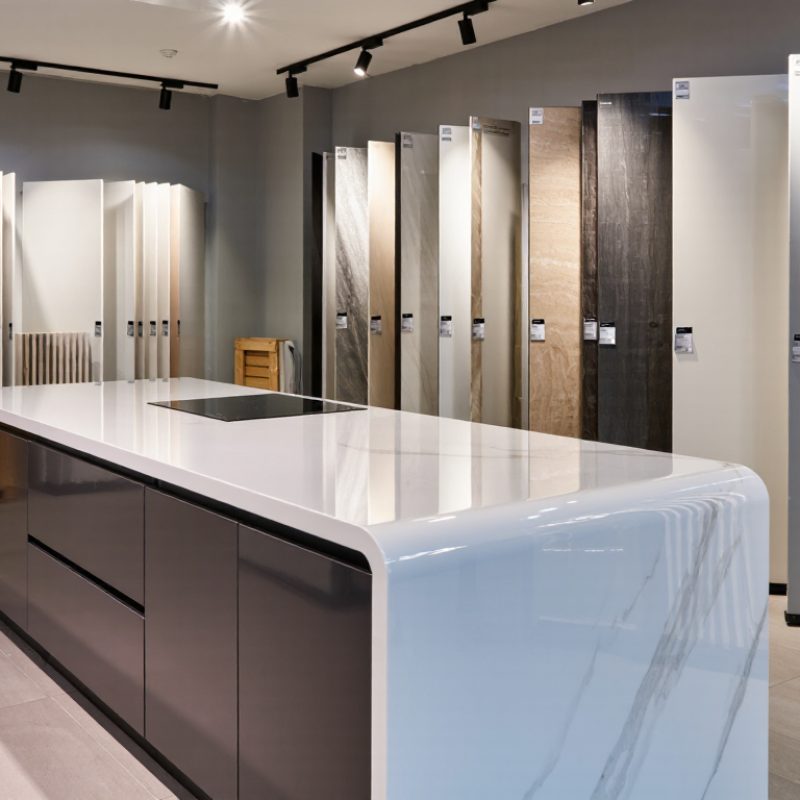
Quartz Composition and Mohs 7 Hardness: What Global Buyers Measure
China Top Quartz: How Strong Is Quartz for Global Buyers?
For global buyers, quartz strength begins with composition. Natural quartz is crystalline silicon dioxide, rated 7 on the Mohs scale. Engineered quartz usually combines quartz aggregate, resin, pigments, and additives. The exact ratio varies by product and factory. That variation matters.
Mohs 7 means quartz can resist scratches from softer materials, including ordinary steel. It does not measure impact strength, bending strength, or heat resistance. A countertop may resist daily abrasion yet chip at an exposed corner. Hardness is not toughness. Buyers should request test reports for flexural strength, water absorption, stain resistance, and thermal performance. Samples should also be checked under strong side lighting. Small pinholes and uneven particles can become visible there.
During quality inspections, I would compare several slabs from the same order. Measure thickness at different points. Check polished edges, color consistency, and surface flatness. A simple scratch test can support laboratory data, but it cannot replace it. Some buyers focus too heavily on the Mohs number. That is understandable, but incomplete. Resin content may affect heat behavior and long-term appearance. Installation quality also influences cracking, especially around cutouts and unsupported spans. Ask for current batch records, clear tolerance ranges, and independent test evidence. Supplier claims deserve verification. Even good quartz can fail when handling, transport, or installation is poorly controlled.
China Top Quartz: How Strong Is Quartz for Global Buyers?
Quartz is crystalline silicon dioxide (SiO₂) and ranks 7 on the Mohs hardness scale, making it harder than common reference minerals such as feldspar and apatite.
What global buyers measure: Mohs hardness indicates scratch resistance, not impact strength or flexural strength. Quartz scores 7, while topaz, corundum, and diamond rank higher at 8, 9, and 10 respectively.
Engineered Quartz Performance: ASTM C97 Water Absorption Benchmark ≤0.5%
China Top Quartz: How Strong Is Quartz for Global Buyers?
Engineered quartz is often judged by appearance, but water resistance deserves equal attention. ASTM C97 measures water absorption in dimension stone and quartz-based materials. A result of ≤0.5% indicates very limited moisture uptake under laboratory conditions. That figure matters around kitchen sinks, bathroom walls, islands, and commercial counters.
In practical inspections, technicians dry, weigh, immerse, and reweigh prepared specimens. The weight difference determines the absorption percentage. Testing must follow the stated procedure carefully. Poor sample preparation can distort results. A low value supports better stain resistance, easier maintenance, and stronger confidence in humid environments.
Still, ASTM C97 is not a complete performance report. It does not measure every risk, including impact damage, thermal shock, edge weakness, or installation defects. Ask for recent test reports, specimen details, and batch information. Results can vary slightly between production lots. That part deserves attention.
A ≤0.5% benchmark is useful, not magical. A dense slab may still fail after careless cutting or weak support. Buyers should also inspect the polished surface, seams, underside, and packaging before installation. For global projects, compare laboratory data with local climate, cleaning habits, and installation requirements. Performance depends on the whole system.
Flexural Strength Testing: ASTM C880 Methods and 40–70 MPa Ranges
China Top Quartz: How Strong Is Quartz for Global Buyers?
Flexural strength shows how well quartz resists bending before failure. ASTM C880/C880M provides a recognized method for testing dimension stone under controlled loading. The specimen rests on two supports and receives force near the center. A calibrated machine records the breaking load and calculates strength in MPa. Many quartz products report values between 40 and 70 MPa. This range is useful, but it is not universal. Composition, thickness, reinforcement, moisture, and surface finish can change the result.
A reliable report should identify the specimen direction, dimensions, conditioning, and failure pattern. Dry and wet results may differ noticeably. Buyers should also confirm whether the tested material is natural quartzite or engineered quartz. ASTM C880 may guide testing, but product specifications can require additional methods. A 65 MPa result sounds strong. It still cannot predict every countertop edge or transport impact. Real installations are less tidy. Small chips, unsupported overhangs, or uneven cabinets can reduce practical performance.
Tips: Ask for recent laboratory reports, not only brochure figures. Check the average, minimum, and number of specimens. Request wet-condition data for kitchens and bathrooms. Review support spacing and thickness before comparing suppliers. I would also inspect a full-size sample when possible; small laboratory pieces cannot show every installation risk.
Abrasion and Surface Durability: ASTM C241 Performance Indicators
China Top Quartz: How Strong Is Quartz for Global Buyers?
Quartz is hard, but hardness is not the same as wear resistance. USGS mineral references place quartz at Mohs 7. This explains its resistance to everyday scratching, but it does not replace performance testing. ASTM C241/C241M evaluates abrasion resistance under controlled foot-traffic conditions. The result helps buyers compare surface loss after repeated abrasive contact. It does not measure impact strength, staining, thermal shock, or edge chipping.
ASTM C241/C241M
Evaluates abrasion resistance under controlled foot-traffic conditions.
For global buyers, request the complete ASTM C241 report, including the test method, specimen condition, abrasive type, and reported value. A polished surface may show marks sooner than a honed finish, even when the substrate is similar. Independent laboratory testing is more reliable than a supplier’s isolated claim. My own buying mistake was treating Mohs hardness as a complete durability answer. It was not.
Tips:
Compare identical finishes and thicknesses. Ask for production-batch traceability. Check whether testing used cured samples, not fresh material. Review abrasion results beside water absorption and flexural strength data. ASTM C241 is useful, but one number can still mislead. Surface wear also depends on grit, traffic, cleaning habits, and installation quality.
Reference: ASTM C241/C241M, Standard Test Method for Abrasion Resistance of Stone Subjected to Foot Traffic; U.S. Geological Survey mineral references.
Global Quality Compliance: EN 14617, ASTM C373, and ISO 10545-4
For global buyers, quartz quality is not judged by appearance alone. A bright surface can still hide weak edges, uneven density, or inconsistent water absorption. Testing should follow the project specification and the product’s actual composition.
EN 14617 provides relevant test methods for agglomerated stone products, including water absorption, flexural strength, and dimensional performance. It helps buyers assess whether quartz slabs remain stable during fabrication and installation. ASTM C373 measures water absorption, bulk density, and specific gravity. Although developed for ceramic products, it is often requested for comparable performance checks. The test scope must be confirmed before acceptance.
ISO 10545-4 evaluates breaking strength and modulus of rupture for ceramic tiles. For quartz applications, buyers should use it only when the contract or laboratory approves its suitability. Test the actual batch. Small details matter.
A reliable supplier should provide dated reports, sample identification, laboratory information, and clear test conditions. Check slab thickness, cut-out areas, polished edges, and support spacing during inspection. A passing report does not guarantee every shipment will perform identically. Batch variation remains possible, especially when raw materials or pressing conditions change.
I would also compare test results with real installation risks. Kitchen cut-outs, long overhangs, transport vibration, and thermal changes can expose weaknesses. Standards improve confidence, but careful sampling and independent verification still matter.