Leave Your Message

Top 10 Uses for Quartz Round Bottom Flask in Scientific Experiments?

The Quartz Round Bottom Flask is a staple in scientific laboratories. Its unique shape and material make it highly effective for various experiments. This flask can endure high temperatures, making it ideal for reactions requiring heat.

In the world of chemistry, precision is crucial. The Quartz Round Bottom Flask provides an even distribution of heat, enhancing reactions. Its resistance to thermal shock ensures safety during experiments. However, not all users appreciate its benefits. Some may overlook its importance due to unfamiliarity.

It is essential to explore the diverse applications of the Quartz Round Bottom Flask. From distillation to crystallization, this flask plays a vital role. Understanding its uses can improve experimental outcomes. Familiarity with this tool can lead to more accurate results. While many use it regularly, a deeper comprehension is beneficial.
Top 10 Uses for Quartz Round Bottom Flask in Scientific Experiments?

Key Applications of Quartz Round Bottom Flask in Chemical Synthesis

The quartz round bottom flask plays a vital role in chemical synthesis. Its unique properties make it ideal for various laboratory applications. The material itself can withstand high temperatures and offers excellent resistance to chemical reactions. These flasks are essential in processes like distillation, which is crucial for separating compounds.

Recent studies indicate that quartz glass can handle temperatures up to 1200°C. This permits the use of the flask in high-temperature reactions, essential for synthesizing complex compounds. As research in chemical engineering advances, the demand for robust glassware like the quartz round bottom flask has increased significantly.

Through the use of these flasks, scientists can monitor reactions more effectively. Visual observation is key in many experiments. The translucent nature of quartz allows chemists to identify color changes and assess reaction progress instantly. However, users often face challenges in cleaning and maintaining the flasks. Persistent residues can impact the quality of future experiments. Attention to detail is crucial in laboratory settings to ensure the integrity of results.

Top 10 Uses for Quartz Round Bottom Flask in Scientific Experiments

Use Case Description Key Advantages
Chemical Synthesis Used for conducting various chemical reactions by providing an optimal environment. High thermal resistance and chemical inertness.
Distillation Ideal for performing distillations due to its shape allowing efficient heat distribution. Uniform heating and reduced risk of breaking.
Heating Reactions Used for heating mixtures and solutions efficiently over a flame or heating mantle. Excellent resistance to thermal shock.
Refluxing Commonly used in reflux setups for prolonged heating of reactions. Minimized loss of solvents and reactants.
Solvent Extraction Utilized in solvent extraction processes to separate compounds. High efficiency and reduced contamination risk.
Crystallization Facilitates the crystallization of pure compounds from solutions. Promotes crystal growth due to its shape.
Sample Storage Used for storing chemical samples safely in laboratories. Provides clear visibility and easy handling.
Reaction Monitoring Allows for visual inspection of reactions through transparent glass. Facilitates real-time monitoring without contamination.
Aromatic Synthesis Effective in synthesizing aromatic compounds through various reactions. Reliable containment of volatile compounds.
Polymerization Used in polymerization reactions to synthesize new materials. Allows for controlled reaction conditions.

Role of Quartz Round Bottom Flasks in High-Temperature Reactions

Quartz round bottom flasks are essential in high-temperature reactions. Their ability to withstand extreme heat makes them ideal for various applications. Unlike other materials, quartz transmits UV light. This property is beneficial for specific chemical reactions that require ultraviolet activation. Users often find that quartz’s thermal stability minimizes the risk of breakage.

When conducting high-temperature experiments, precision is critical. The round bottom shape allows for uniform heating. This design helps maintain consistent temperature throughout the flask. However, some may overlook the importance of proper stirring. Uneven mixing can lead to inaccurate results. It's crucial to reflect on whether the reaction parameters are being met.

Users occasionally face challenges when cleaning these flasks. Quartz surfaces can develop residues that are hard to remove. Chemical cleaners can sometimes cause scratches. These imperfections could impact future experiments. Taking the time to ensure proper care is essential for maintaining their integrity. Ultimately, the effectiveness of quartz round bottom flasks relies on both their physical properties and user diligence.

Advantages of Using Quartz Round Bottom Flasks for Vacuum Distillation

Quartz round bottom flasks are valuable in vacuum distillation. Their high thermal stability is a major advantage. This stability allows for rapid heating and cooling, which is essential in experiments requiring precise temperature control. The glass material is non-reactive, ensuring that the substances inside remain pure. Researchers appreciate this quality, but it does require careful handling. Any mishap could compromise the integrity of the experiment.

Using quartz flasks for vacuum distillation offers even more benefits. The clarity of quartz enables researchers to observe reactions easily. This can help in identifying phases during the distillation process. However, visibility might not always guarantee accuracy. Sometimes, visual observations can mislead if not properly correlated with data.

Additionally, quartz can withstand significant pressure differences. This feature makes it ideal for vacuum applications, where traditional glass may fail. Yet, users must regularly check for flaws. A small crack can lead to disaster. This constant vigilance is crucial for successful outcomes in scientific experiments.

Impact of Quartz Material on Purity in Scientific Experiments

Top 10 Uses for Quartz Round Bottom Flask in Scientific Experiments?

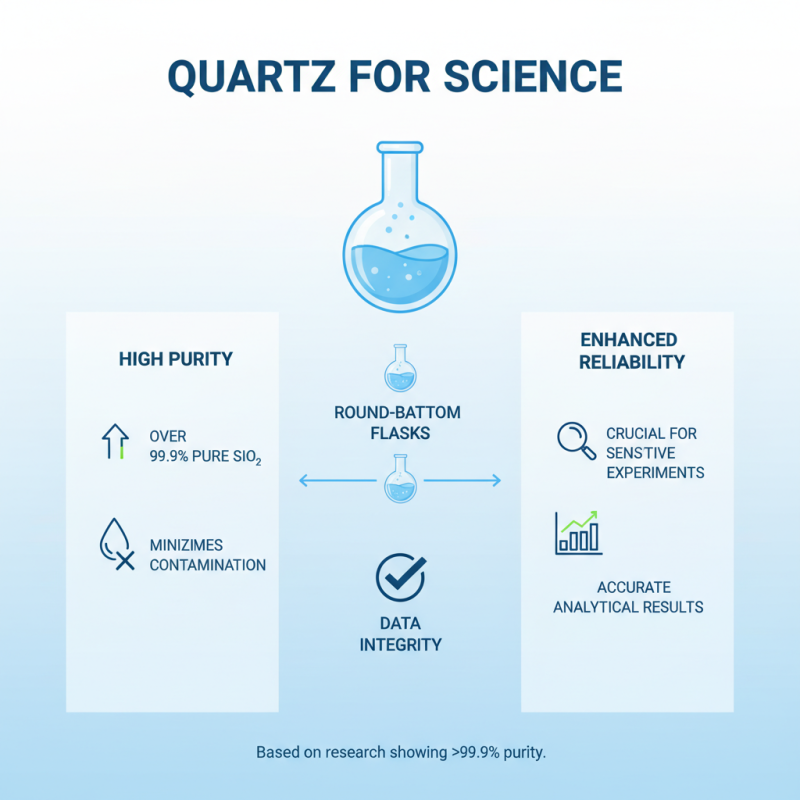
Quartz has unique properties that make it ideal for scientific experiments. One of its key advantages is its high purity level. Research shows that quartz has a purity rate of over 99.9%. This minimizes contamination, which is crucial in sensitive experiments. For instance, in analytical chemistry, even trace levels of impurities can skew results. Therefore, using quartz round bottom flasks can significantly enhance data reliability.

Additionally, quartz withstands high temperatures. This allows for reactions that require heating without the risk of leaching contaminants into the solution. A study indicates that at temperatures above 1000°C, quartz maintains its integrity, unlike other materials that may degrade. The use of quartz reduces the need for cleanup, as it does not react with most chemicals. This can save time and increase efficiency in the lab.

However, there are considerations when using quartz. Its fragility can lead to breakage, which poses safety risks. Moreover, the high cost of quartz equipment can limit access for some laboratories. These factors necessitate careful planning in budgeting and handling. Ensuring that the benefits outweigh these challenges is crucial for effective lab operations.

Safety and Durability of Quartz Round Bottom Flasks in Laboratory Settings

Quartz round bottom flasks are invaluable in laboratory settings due to their safety and durability. Made from high-quality quartz, these flasks can withstand high temperatures. This makes them ideal for conducting reactions that require heating. The transparency of quartz also allows easy observation of the contents. However, care must be taken during handling to avoid sudden temperature changes that can cause cracking.

In terms of durability, quartz flasks excel compared to glass and plastic. They resist chemical corrosion, making them suitable for various reagents. While they are stronger, they are not unbreakable. Accidental drops can still lead to breakage. Therefore, proper storage and handling protocols are essential. Despite their resilience, labs often report wear and tear over time. Regular inspections help ensure safety standards are met. Recognizing these details is vital for maintaining an efficient laboratory environment.

Top 10 Uses for Quartz Round Bottom Flask in Scientific Experiments

This chart illustrates the top ten uses for quartz round bottom flasks in laboratory settings, showcasing their safety and durability in various applications.