Top 5 Tips for Choosing the Right Quartz Glass Crucible?
Choosing the correct Quartz Glass Crucible is vital for various industrial applications. As Dr. Emily Carter, a renowned expert in materials science, states, “The right crucible can make or break your experimental results.” This highlights the profound impact of this decision.
Quartz glass crucibles are known for their high temperature resistance and chemical durability. Selecting the right one ensures reliable performance in critical processes. The industry offers a wide variety, making choices daunting for newcomers. Factors such as size, thickness, and thermal shock resistance are crucial.
In a fast-evolving market, staying informed is essential. An oversight in selection can lead to significant issues, like material contamination or failures. Therefore, a deeper understanding of quartz glass crucibles is paramount. Navigating these choices requires both expertise and careful consideration.
Understanding Quartz Glass Crucibles and Their Applications
Quartz glass crucibles are essential tools in many scientific and industrial applications. They are prized for their ability to withstand high temperatures and chemical resistance. In laboratories, these crucibles are used for experiments involving solid and liquid materials. Their clarity allows for visual inspection during reactions, which is crucial for accuracy.
While selecting a quartz glass crucible, understanding its properties is vital. Different grades offer various thermal stability levels and chemical compatibilities. High-purity quartz is more reliable for precise experiments. However, not all applications require the highest grade, leading to potential cost savings. It's critical to balance quality and functionality based on specific needs.
Without proper knowledge, choosing the wrong crucible can lead to failures in experiments or processes. Users often overlook the importance of size and shape, which can impact results significantly. A crucible that is too large may lead to inefficient heating, while an improper shape could affect stirring or mixing. Each detail matters, and taking the time to reflect on these aspects can enhance the success of your projects.
Top 5 Tips for Choosing the Right Quartz Glass Crucible
| Tip |
Description |
Application |
Temperature Resistance (°C) |
| 1. Check Purity |
Ensure the quartz glass is of high purity for accurate results. |
Chemical analysis |
1000 |
| 2. Assess Size |
Choose the correct size based on your specific experimental needs. |
Crystallization processes |
1200 |
| 3. Evaluate Shape |
Consider the shape for optimal heating and material processing. |
Material synthesis |
1400 |
| 4. Verify Thermal Shock Resistance |
Ensure the crucible can withstand rapid temperature changes. |
High-temperature experiments |
1500 |
| 5. Inspect for Defects |
Look for any cracks or imperfections that may affect performance. |
General laboratory use |
1000 |
Key Factors to Consider When Selecting Quartz Glass Crucibles
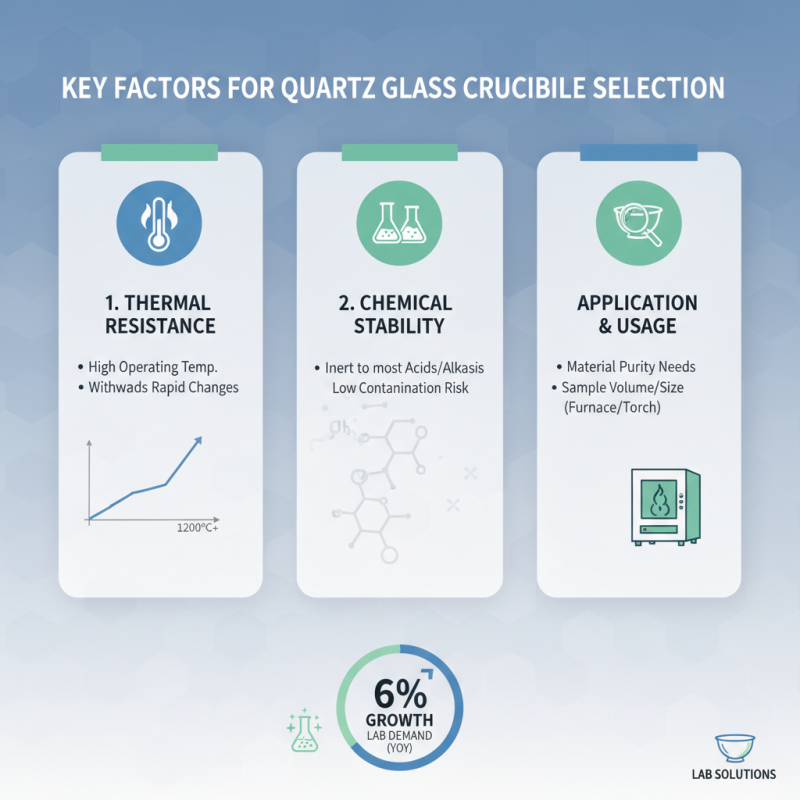
Choosing the right quartz glass crucible requires careful consideration of several key factors. Quartz glass is known for its high thermal resistance and excellent chemical stability. According to a recent industry report, the demand for quartz glass crucibles in laboratories has seen a year-on-year growth of about 6%. This increases the need for precise selection based on usage.
One important factor to consider is the crucible’s thermal expansion coefficient. A lower coefficient minimizes the risk of thermal shock during rapid temperature changes. For instance, crucibles with a coefficient below 0.5 × 10⁻⁶ °C⁻¹ are generally more reliable. Another aspect is size. Ensure that the crucible dimensions are appropriate for your exact application. An ill-fitting crucible can cause contamination or loss of sample integrity.
When selecting quartz glass crucibles, consider the purity grade as well. Higher purity grades, such as 99.99%, are ideal for sensitive applications, especially in semiconductor processing. Always check the specifications provided by manufacturers. This attention to detail can significantly impact your results. In conclusion, prioritizing factors like thermal stability, size, and purity can lead to better outcomes in your projects.
Evaluating Quality: Material and Manufacturing Standards
When choosing a quartz glass crucible, evaluating material and manufacturing standards is essential. Quality materials ensure durability. The composition of the quartz glass can influence how well it withstands thermal stress. Look for crucibles with high purity levels. Impurities can lead to unexpected reactions during experiments.
Manufacturing standards also matter. A well-constructed crucible should have uniform thickness. This uniformity prevents weak points that could cause breakage. Manufacturing processes should follow stringent protocols to minimize defects. Consider suppliers who are certified in quality assurance. Such certifications can indicate a commitment to excellence.
Not all quartz glass crucibles are created equal. Some may show inconsistencies in clarity or surface finish. Inspecting a crucible before purchase is beneficial. Check for bubbles or inclusions that could compromise its integrity. Reflect on the consequences of choosing a subpar product. The wrong crucible could affect your results significantly.
Sizing and Capacity: Matching Crucibles to Your Needs
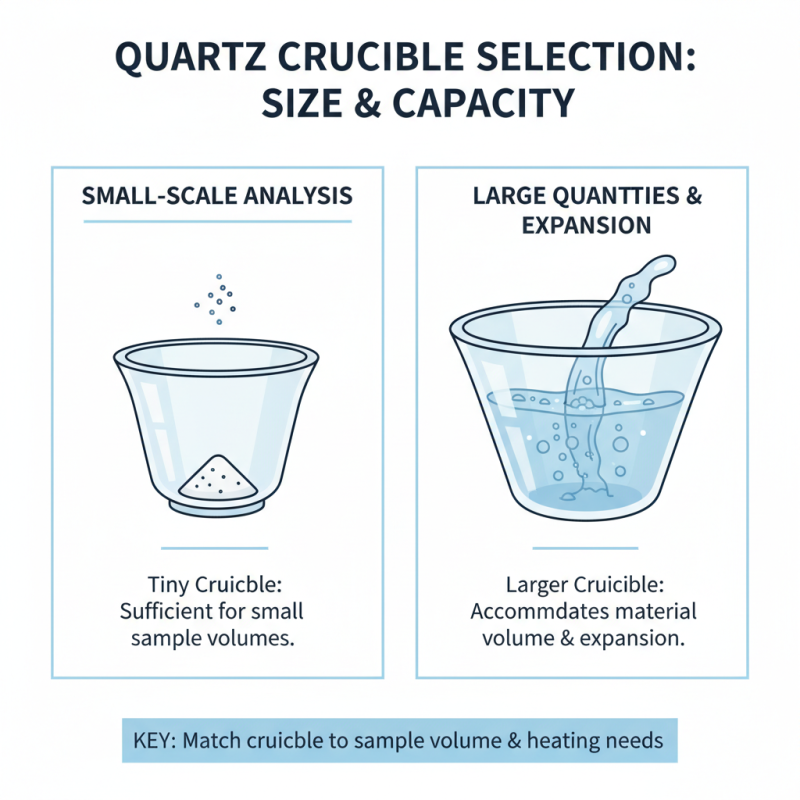
When selecting quartz glass crucibles, sizing and capacity are crucial factors. A crucible's size needs to align with your specific application. For small sample analyses, a tiny crucible may be sufficient. However, for larger quantities, you need something that holds more material. Consider both the sample's volume and the potential for expansion during heating.
It can be tricky to estimate how much material your projects require. If the crucible is too small, you risk spills or mishandlings. Conversely, oversizing may waste resources and energy. Take time to assess your typical sample volume before making a decision. Users sometimes underestimate this aspect, leading to inefficient processes.
In addition, think about future projects. Will you be scaling up? Planning ahead can save you from additional purchases later on. It’s beneficial to consult measurements and previous experiences to ensure you choose wisely. Remember, the right fit makes the difference in achieving accurate results and maintaining a safe workspace.
Comparative Costs: Balancing Quality and Budget in Your Purchase
When considering quartz glass crucibles, it’s essential to balance quality with budget. Research indicates that top-quality crucibles can last up to three times longer than cheaper alternatives. Price disparities often stem from the materials and technology used in manufacturing. According to a 2021 industry report, investing in high-quality crucibles can yield long-term cost savings due to reduced replacements and maintenance.
Nevertheless, not every application demands high-end products. For less critical tasks, opting for mid-range options might suffice. A 2020 survey revealed that 40% of users reported satisfactory performance from mid-tier crucibles in lab settings. This suggests that choosing based solely on price can be misleading. Certain suppliers may offer lower prices, but the quality might be compromised. In these cases, users should be vigilant and seek material certifications.
Ultimately, every purchase should involve weighing performance against costs. Accurate assessments require understanding specific application needs. In some scenarios, a higher initial investment in quality crucibles can translate into greater efficiency. Balancing these factors effectively demands careful consideration. Users must analyze both short-term expenses and long-term implications.