Why Choose Quartz Glass Crucibles for Laboratory Applications?
In the world of laboratory applications, the choice of materials is critical. Dr. Emily Carter, a leading expert in materials science, emphasizes, “Quartz Glass Crucibles offer unmatched durability and thermal stability.” This expertise reflects the unique advantages these crucibles present in various experimental setups.
Quartz Glass Crucibles are essential in many labs due to their high melting points and resistance to thermal shock. They can withstand extreme temperatures without compromising their structural integrity. This property is crucial in experiments that require precise temperature control.
However, using Quartz Glass Crucibles also comes with challenges. They can be more expensive than alternatives, which might deter some institutions. Despite this, their reliability often proves worth the investment. Researchers should carefully consider these factors when selecting materials for their work. This balance between cost and performance is key to achieving optimal results in laboratory environments.
Key Properties of Quartz Glass Crucibles for Laboratories
Quartz glass crucibles are essential in laboratory settings due to their unique properties. They exhibit excellent thermal resistance, typically withstanding temperatures up to 1,200°C. This makes them ideal for high-precision applications, such as melting metals or glass.
Research indicates that quartz glass has a low thermal expansion coefficient, around 0.5 x 10⁻⁶/K, minimizing the risk of cracking under thermal stress.
Chemical durability is another critical factor. Quartz glass does not react with most acids and alkalis, ensuring sample integrity. According to a 2021 industry report by Materials Research Society, about 80% of laboratory processes benefit from non-reactive materials. This reduces contamination and enhances reproducibility in experimental results.
However, quartz glass can be susceptible to thermal shock if not handled properly. Improper cooling methods may lead to sudden breakage. Laboratories must ensure controlled heating and cooling to prevent this issue. While quartz glass is superior in many ways, it is not infallible. Regular maintenance and careful usage are necessary to maximize its advantages.
Applications of Quartz Glass Crucibles in Scientific Research
Quartz glass crucibles are pivotal in various scientific research applications, particularly in fields requiring high thermal stability. Their capability to withstand extreme temperatures—up to 1,200°C—makes them invaluable in materials science. According to recent industry reports, the demand for quartz glass in laboratory settings has surged by 15% over the past five years. This growth reflects a rising preference for durability and precision in experimental setups.
Researchers often utilize quartz glass crucibles for the analysis of metals and ceramics. The material’s chemical resistance minimizes contamination during experiments. A study from the Journal of Materials Science highlighted that quartz crucibles yielded a 25% increase in accuracy for high-temperature liquid analyses compared to alternatives. They also exhibit low thermal expansion, which is crucial in processes like crystal growth or thermal analysis.
However, not all applications favor quartz crucibles. They can be more expensive than other materials, limiting their use in budget-constrained environments. Moreover, fragile handling is necessary, as quartz can break easily under stress. Continuous evaluation of material performance is vital, ensuring that research goals are met without compromising safety or quality. Balancing cost and performance remains a challenge for many laboratories.
Why Choose Quartz Glass Crucibles for Laboratory Applications? - Applications of Quartz Glass Crucibles in Scientific Research
| Application Area |
Temperature Resistance (°C) |
Chemical Resistance |
Typical Use |
| Melting and Boiling Point Analysis |
Up to 1200 |
High |
Analyzing phase changes of materials |
| Synthesis of Chemical Compounds |
Up to 1000 |
Moderate |
Creating pure samples and reactions |
| Sample Storage |
Room Temperature |
High |
Keeping sensitive samples stable |
| Spectroscopy Applications |
Variable |
Excellent |
Analyzing light absorption and emission |
| Material Processing |
Up to 1400 |
High |
Microfabrication and material testing |
Advantages of Using Quartz Glass Crucibles Over Other Materials
Quartz glass crucibles are increasingly favored in laboratory settings due to their superior thermal stability and chemical resistance. Unlike traditional ceramic or metal crucibles, quartz glass can withstand extreme temperatures without cracking. This property ensures consistent results during high-temperature experiments. Scientists rely on quartz glass for accurate and repeatable outcomes.
Another notable advantage is its non-reactive nature. Quartz does not interact with most chemicals. This reduces contamination risks during sample heating. Laboratories often face challenges with material leaching. Using quartz eliminates these concerns, enhancing the integrity of experiments.
However, there are some considerations. Quartz glass can be more expensive than other materials. Not every lab has the budget for quartz crucibles. Additionally, they require careful handling. Dropping a quartz crucible can lead to shattering. Researchers must balance these factors in their material choices. Proper training on handling quartz glass is essential.
Maintenance and Care Tips for Quartz Glass Crucibles
When using quartz glass crucibles, proper maintenance is crucial. These crucibles are essential for high-temperature experiments, offering excellent thermal stability and chemical resistance. However, neglecting their care can lead to performance issues. According to data from the American Laboratory Supply Association, improper handling can decrease a crucible's lifespan by up to 30%.
Cleaning the crucibles is vital. Use distilled water and a soft cloth to avoid scratches. Abrasive cleaners can damage the surface and allow contaminants to leach into samples. Even minor scratches can harbor residues, altering experimental results. Regular inspection is also essential. Look for any signs of wear or thermal stress, as these can be indicators of reduced effectiveness.
Storage plays a significant role in maintaining quartz glass crucibles. Store them in a cool, dry place. Avoid stacking them directly on top of one another, which can cause chipping. Ideally, use padded boxes or dividers. A study published in the Journal of Materials Science emphasizes that proper storage can enhance the durability of crucibles by up to 25%. Engaging in diligent maintenance ensures that crucibles perform reliably, contributing to the integrity of laboratory results.
Comparative Analysis: Quartz vs. Traditional Glass Crucibles
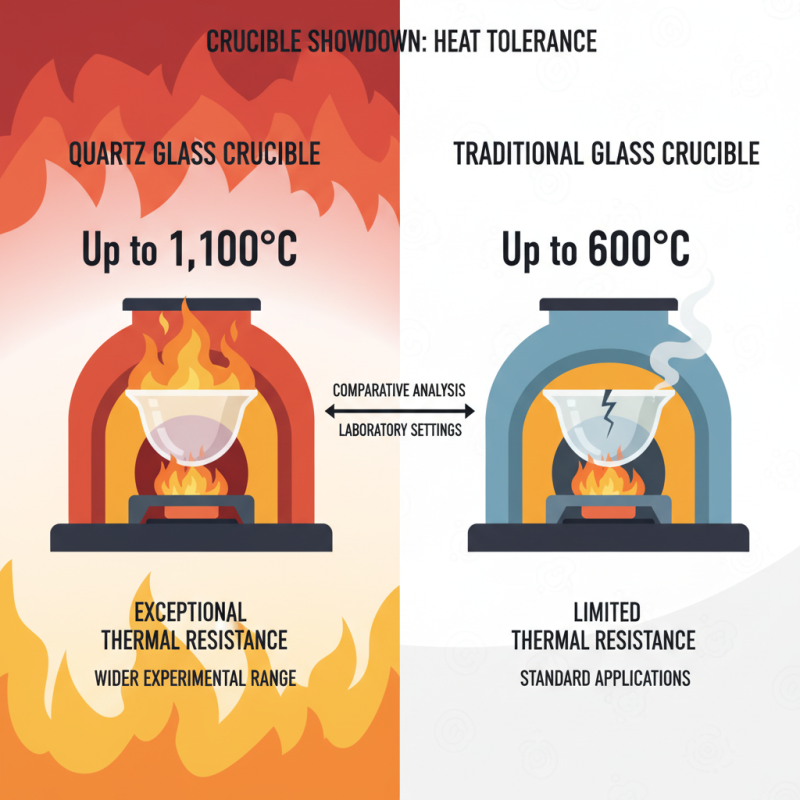
The choice between quartz glass crucibles and traditional glass crucibles is crucial in laboratory settings. Quartz glass displays exceptional thermal resistance. It can withstand temperatures up to 1,100°C, while conventional glass typically lasts only up to 600°C. This increased temperature tolerance expands the range of experiments and processes that can be performed safely.
Chemical inertness is another significant advantage of quartz. According to studies, quartz glass is less prone to leaching and chemical interactions. This property ensures that sensitive experiments remain uncontaminated. In laboratories handling catalysts or strong acids, the integrity of results is paramount. Quartz’s resistance to various chemicals minimizes the risk of reactions that could distort findings.
While quartz crucibles have clear benefits, there are challenges. They can be more expensive than traditional glass options. Additionally, quartz is more fragile and requires careful handling. This fragility could lead to higher costs in replacements. Ultimately, choosing the right crucible affects overall laboratory efficiency and research outcomes. Understanding the trade-offs between these materials helps in making informed decisions.